News & Stories

Q&A with Daniel follow up from Milken Institute event

Q&A with PUR’s CEO Daniel Klier: Why nature-based solutions are moving from “nice to have” to investable climate infrastructure


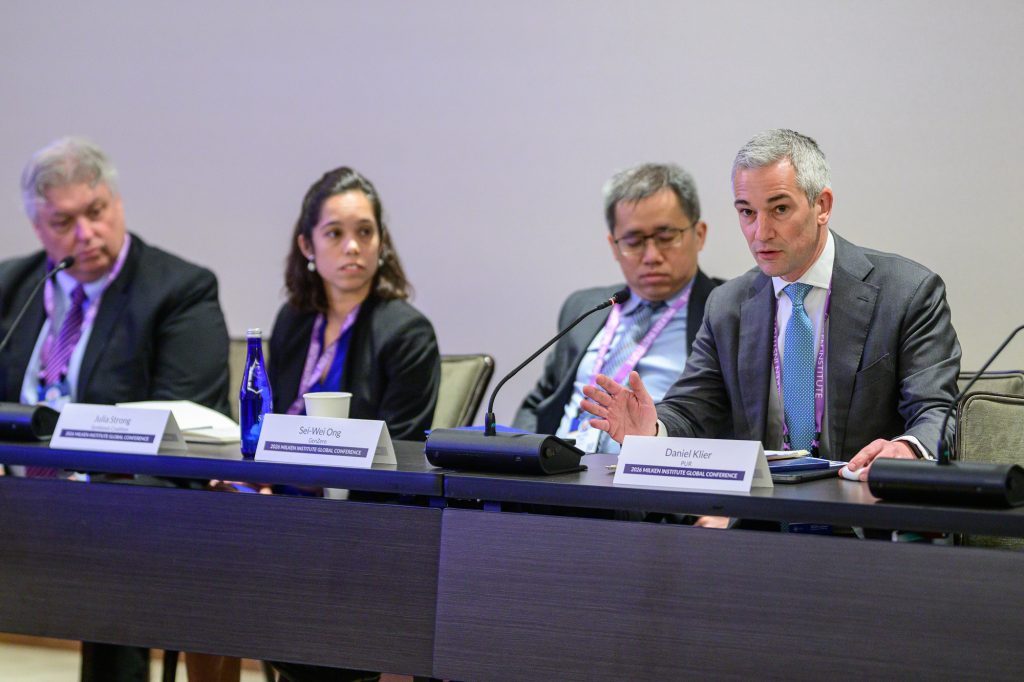
Following his participation in the Milken Institute Global Conference in Los Angeles (“Carbon Markets: Dollars at Work”), PUR CEO Daniel Klier sat down with us to share his takeaways on where carbon markets are heading — and why high-integrity nature-based solutions (NbS) are increasingly being viewed through an investor lens.

With a background spanning sustainable finance and climate markets, Daniel explains why compliance demand is changing the conversation, how insetting is becoming a resilience imperative for global supply chains, and what it will take to scale a market that still suffers from fragmentation and under-funded project development.

What was the main message you wanted to bring to the Milken discussion?

That nature-based solutions are no longer a niche sustainability initiative — they’re becoming part of mainstream climate and business strategy. We’re seeing a growing recognition that well-designed projects can deliver multiple forms of value at the same time: climate mitigation and removals, biodiversity and water outcomes, and — critically — supply chain resilience and farmer livelihoods.

For many companies, climate risk has become business risk. In sectors like coffee and cocoa, rising temperatures, water stress and soil degradation directly threaten productivity and sourcing security. That changes the conversation. What started as “carbon programs” increasingly evolves into resilience programs, because protecting ecosystems and supporting farmers is fundamental to protecting long-term supply.

Carbon markets can feel complex. How do you frame them simply?

It helps to distinguish two things.

First, there are allowance-based markets (like emissions trading systems), where companies buy allowances to comply with caps.

Second, there are project-based markets, where companies finance projects that generate credits. Within project-based markets, you then have:

  • Voluntary markets, where companies buy credits to complement decarbonisation efforts; and
  • Compliance-driven markets, where credits are used under regulatory rules and demand is structurally anchored.

Compliance-driven markets can take different forms — a global mechanism (such as what evolves under Article 6), a sectoral system like CORSIA for aviation, or domestic/regional schemes where a company can use eligible credits as a cost-effective alternative to a tax or allowance.

Within the voluntary space, companies also distinguish between insetting and beyond value chain action — largely based on proximity to the company’s own supply chain.
You spoke about the “maturity” of carbon markets. What gives you confidence the market is evolving in the right direction?

Two things stand out.

The first is the growing role of compliance demand. When regulation creates clear demand signals, carbon markets move from being driven only by sustainability teams to becoming a CFO-level discussion. A CFO evaluates trade-offs very simply: Is it cheaper to pay a penalty, or to secure supply through credible long-term projects? Compliance frameworks can create more predictable, long-dated revenue streams — which is exactly what enables investment at scale.

The second is that the market is increasingly adopting structures that investors recognise: long-term offtakes, clearer revenue visibility, and — in some cases — project structures that resemble infrastructure financing. The analogy isn’t perfect, but the point is that once you have strong fundamentals and long-term demand, these projects start to look like long-duration assets.

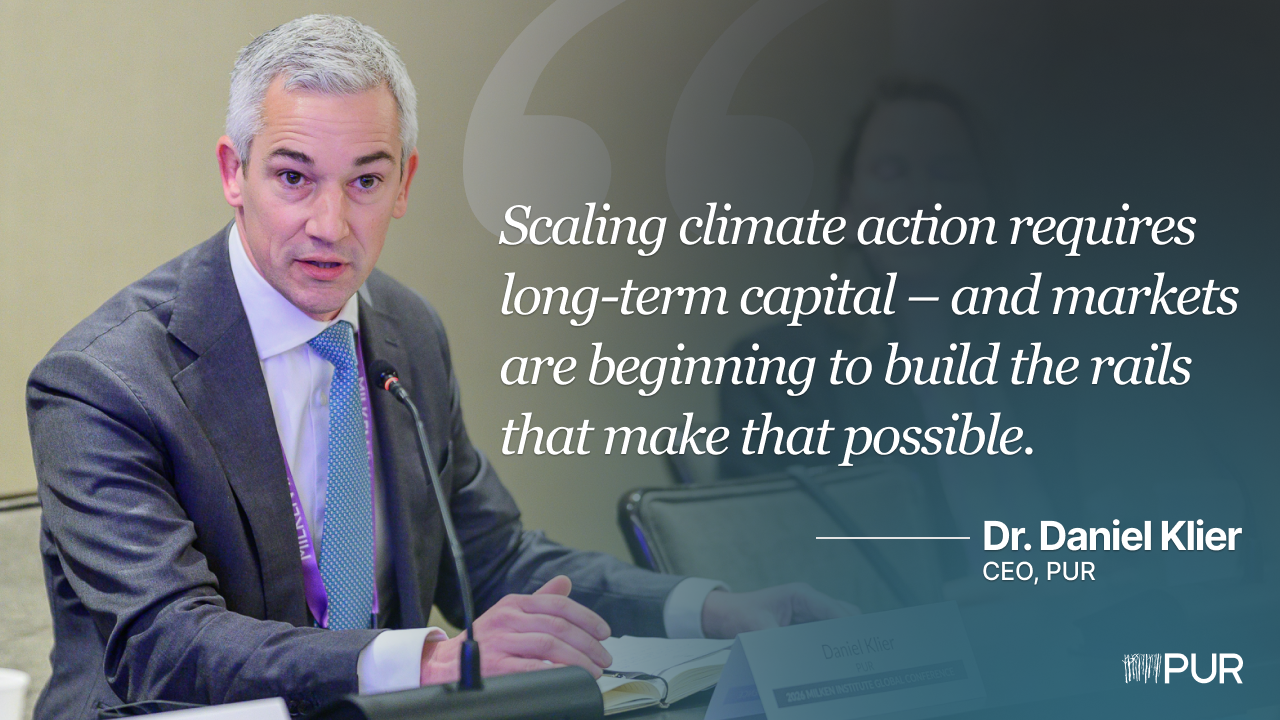
Scaling climate action requires long-term capital — and markets are beginning to build the rails that make that possible.

Dr. Daniel Klier, CEO PUR

How is PUR positioned to help companies navigate this shift?

PUR sits at the intersection of ambition and implementation. Our role is to bridge corporate climate and nature goals with field delivery in real agricultural landscapes.

What differentiates success in nature-based programs is execution: projects aren’t built remotely. They require deep local partnerships, long-term engagement with farmers, and continuous technical support to sustain adoption.

We work with companies to design programs that respond to both climate objectives and operational realities — often integrating agroforestry and regenerative practices directly into supply chains. And we focus heavily on integrity: robust methodologies, transparent monitoring, and realistic risk management are now table stakes. Buyers, investors and regulators are all asking for projects that can withstand scrutiny.

Why is insetting becoming such a priority for large companies?

Because resilience starts inside your own value chain.

Historically, many companies engaged with carbon markets primarily through offsets. Now we’re seeing much stronger interest in insetting — programs implemented directly within sourcing regions, where the company’s supply risk sits.

If you’re sourcing coffee, cocoa or other agricultural commodities globally, climate impacts aren’t theoretical. They’re affecting yields, water availability, pest pressure and livelihoods already.

Agroforestry is a great example of why this matters. Adding trees into agricultural systems can:

  • improve soil health and water retention,
  • provide shade and reduce heat stress,
  • support biodiversity,
  • diversify farmer income through additional species —
  • while also contributing to climate and nature outcomes.

So insetting becomes both a sustainability strategy and a resilience strategy.

What is the impact of AI on nature finance?

The discussion about the future impact of AI dominated the overall conference. We all see the material opportunity from this revolutionary technology but also recognise the challenges. One such challenge is the impact on energy consumption and the environment – in local communities as well as on a global level. Investing in Nature-based Solutions therefore appeared very naturally on the agenda of an otherwise very technology-dominated conference.

What barriers are still slowing growth — and what needs to be unlocked?

The big one is fragmentation and complexity. There are still many standards, methodologies and frameworks, which makes the market hard to navigate — especially for new buyers and investors. Greater alignment and consolidation would help build confidence and scalability.

The second barrier is early-stage project development. High-quality nature-based programs require meaningful upfront investment long before credits or verified outcomes materialise. Developers carry significant early risk in design, community engagement, implementation and validation.

One of the most important unlocks would be more technical assistance facilities and early-stage financing mechanisms that help build high-quality pipelines. There is clear appetite from buyers and investors for credible supply — but we need more support to bring projects to maturity.

The good news is that market infrastructure is improving: more sophisticated risk management tools, stronger offtake structures, and growing institutional interest compared with even three or four years ago. But we still need to close the “pipeline gap” — the gap between demand and investable supply.

Why do you believe NbS will remain central to climate action?

Because they are among the most immediately scalable tools we have — and they deliver multiple outcomes simultaneously.

In a world already experiencing climate impacts, we need solutions that can generate environmental, social and economic benefits together. Nature-based solutions can do that: restoring ecosystems, strengthening water and soil systems, supporting biodiversity, and improving farmer resilience.

That doesn’t mean engineered removals or technology solutions aren’t important — they are. But nature must be part of the equation if we’re serious about achieving climate goals at scale, and doing so in a way that supports people and ecosystems.

How important are partnerships in making these projects successful?

They’re fundamental. No single organisation can scale climate action alone.

Successful programs require coordination between companies, investors, local communities, technical experts and, often, governments. The strongest projects are those where climate objectives, economic incentives and local realities are aligned.

At PUR, we see our role as connecting those stakeholders around credible, long-term programs that deliver measurable outcomes. Ultimately, scaling NbS isn’t only about carbon markets. It’s about building resilient ecosystems, resilient supply chains and resilient communities for the future.

Interested in discussing insetting, resilience programs, or high-integrity nature-based portfolios?
Get in touch with PUR.


PUR

May 20, 2026

Share
[addtoany]

Related Posts

Q&A with Daniel follow up from Milken Institute event

Q&A with Daniel follow up from Milken Institute event

Following the Milken Institute event, PUR CEO Daniel Klier shares his insights on the future of carbon markets and high-integrity...
PUR’s 2024 Impact Report

PUR’s 2024 Impact Report

PUR's core mission is to transform global commodity supply chains, evolving the ways that we grow our food and interact with the...
Two PUR team members inspecting trees

Vermont Success

Vermont’s landscapes are feeling the effects of climate change, with rising temperatures and more frequent floods. Since 2016, PUR and...
How Trees Are Transforming Coffee Farming in Ethiopia

How Trees Are Transforming Coffee Farming in Ethiopia

By working with farmers to integrate trees into their landscapes, PUR is not only improving productivity but also ensuring farms are...
Zemenay’s Story: How agroforestry changed one woman’s farm

Zemenay’s Story: How agroforestry changed one woman’s farm

Nearly half of the agricultural workforce is made up of women, yet many struggle with limited access to land, financial resources,...